
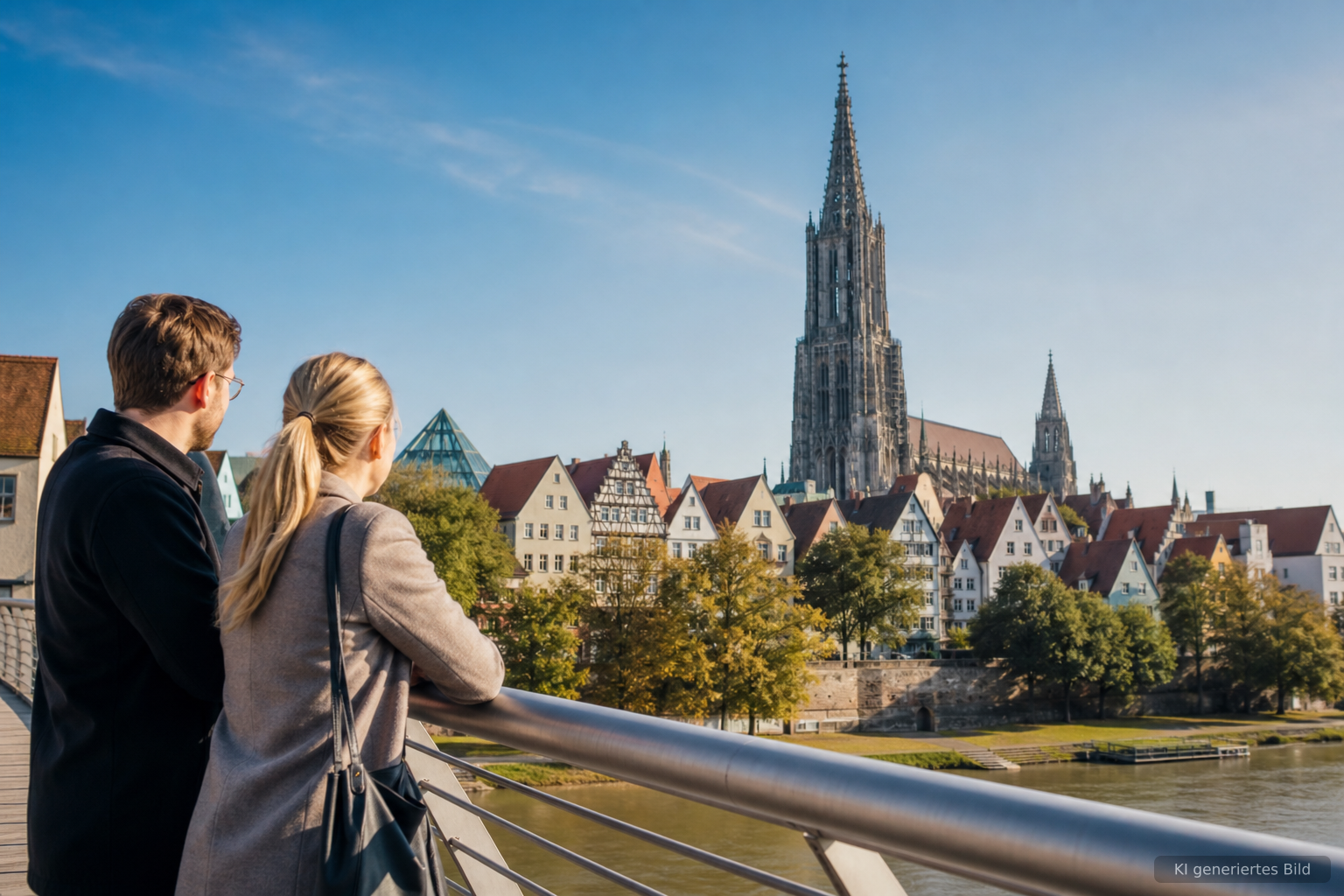


Ulm: city, history & tips 2026
Ulm packs an unusual amount of history, science and industry into a small space. The city sits on the Danube in the south-east of Baden-Württemberg, right on the Bavarian border. Most people think first of the Minster with the tallest church spire in the world. But there is more to it. A centre for research. An industrial hub. And for specialists and executives, a place with a high quality of life. This article sets out the facts about Ulm, walks through its history, names the sights that are worth your time and looks at the city as a business location. Compact, practical and up to date for 2026.
If you want to understand why Ulm matters professionally and economically rather than simply visit it, this overview gives you the orientation you need.
Ulm at a glance: figures, location and character
Ulm lies in the south-east of Baden-Württemberg, on the left bank of the Danube. On the other side of the river Bavaria begins, and with it the independent town of Neu-Ulm. The two form one continuous urban area, but they are administratively separate and belong to different federal states.
The population of Ulm is around 130,000, officially 130,288 as of 31 December 2025. Together with Neu-Ulm, the conurbation is considerably larger. That makes Ulm a regional centre serving a wide catchment area between Stuttgart and Augsburg.
The geography is an advantage. Ulm sits at the meeting point of two large economic regions: greater Stuttgart to the west and greater Munich to the east. Both are easy to reach. That makes the city interesting for companies and commuters alike.
What sets Ulm apart comes down to a few points:
- The Danube shapes the townscape. Ulm counts as one of Germany's most important Danube cities. The river separates Ulm from Neu-Ulm and historically connects the city with the whole Danube region as far as Vienna and Budapest.
- Ulm Minster is the landmark. Its spire holds a world record and is visible from far away.
- The status as a city of science rests on Ulm University, several other higher education institutions and one of the significant research locations in southern Germany.
Ulm combines tradition and modernity. Former Free Imperial City, young research location. That mixture runs through the entire history of the place.
The history of Ulm: from Imperial City to modern research location
Ulm goes back a long way. The first documentary mention dates from 854, when King Louis the German confirmed a royal palace on the site. That early palace was where it all started.
Over the centuries Ulm grew into one of the wealthiest cities of the Holy Roman Empire. The rise to Free Imperial City laid the foundation. Trade, craft and shrewd politics made Ulm powerful. Work on the Minster from 1377 onwards gave that self-confidence a visible form.
Then came the breaks. The loss of imperial immediacy, the transfer to Bavaria and later to Württemberg, industrialisation and finally the heavy destruction of the Second World War. After 1945 Ulm rebuilt itself. Out of the ruined city grew a modern location for science and industry. The sections below set out that development.
The Middle Ages and the years as a Free Imperial City
Ulm received its town charter in 1181. From then on things moved upwards. The town lay on important trade routes and profited from long-distance commerce. Trade in fustian, a mixed fabric of cotton and linen, brought particular wealth. Merchants from Ulm were active across Europe.
In 1274 King Rudolf of Habsburg confirmed the town's privileges. Ulm became a Free Imperial City, answering directly to the emperor rather than to a territorial ruler. That independence was the basis for a long period of prosperity. The territory controlled by Ulm grew into one of the largest city domains in the empire.
Economic success showed in the architecture. In 1377 the citizens laid the foundation stone of Ulm Minster. Worth noting: the town financed the building itself, without a bishop or a prince. The Minster was a citizens' project. Pride and prosperity, in stone.
Ulm reached the height of its power in the 15th and early 16th centuries. It was among the largest and richest towns in southern Germany. Art and craft flourished. Sculptors and painters such as Hans Multscher shaped a distinct Ulm school.
With the Reformation, Ulm adopted the Protestant faith in 1530. The religious and political conflicts of the following decades weakened the town, however. The Thirty Years' War hit Ulm hard in the 17th century. Trade declined, the population shrank. The great era as a leading Imperial City slowly came to an end.
The 19th and 20th centuries: industry, war and reconstruction
In 1802 Ulm lost its status as a Free Imperial City and passed first to Bavaria. In 1810 the part of the city on the left bank of the Danube went to the Kingdom of Württemberg. Neu-Ulm on the right bank stayed Bavarian. That division still has effects today: two cities, two federal states, one conurbation.
From the 1840s onwards Ulm was expanded into a federal fortress. The extensive fortifications were meant to secure the German Confederation against France. Parts of them still shape the townscape and some are open to visitors.
Industrialisation reached Ulm with the railway. The rail connection came in 1850. Factories were built. The city grew. Mechanical engineering, vehicle construction and metalworking settled here. Ulm developed into an industrial centre on the Danube.
The Second World War marked a caesura. On 17 December 1944 a heavy air raid destroyed large parts of the old town. Much of the historic building stock was lost. The Minster survived largely intact, but the city around it lay in ruins.
Reconstruction began after 1945. Ulm opted for a modern redesign while keeping important buildings and quarters. The Fischerviertel was restored. New residential districts and industrial estates were built. In 1967 the state founded Ulm University. That step laid the ground for today's research city. The ruined Imperial City became a location for research, technology and industry.
Sights in Ulm: what you really should have seen
Ulm has more sights than a day trip can hold. But a few belong on every list. What follows is a selection with a clear benefit for visitors rather than a catalogue.
Four destinations stand out. Ulm Minster as the landmark. The Fischerviertel as the historic heart. The city wall along the Danube. And the Kunsthalle Weishaupt for modern art.
The four combine well into a single day. They lie close together in the old town. First-time visitors cover the essentials with them: history, architecture, atmosphere and culture.
The next two sections go into detail on the two most important of them. The Minster and the Fischerviertel are worth a closer look.
Ulm Minster: the tallest church spire in the world
At 161.53 metres, Ulm Minster has the tallest church spire in the world. That figure is undisputed and makes the Minster the best-known building in the city. Construction started in 1377 and was only completed in 1890, more than 500 years later.
Anyone climbing the tower can expect a panorama. 768 steps lead to the highest accessible platform at around 143 metres. In clear weather the view reaches the Alps. The climb is demanding but manageable. Sturdy shoes and a head for heights help.
The Minster is a Protestant church. Despite its size it is occasionally called a cathedral, which is strictly speaking wrong. A cathedral is the seat of a bishop, and Ulm Minster never was one. It was and remains a citizens' church.
Fischerviertel and the Crooked House: Ulm off the tourist trail
The Fischerviertel lies south-west of the Minster, right on the water. The small river Blau and a network of channels run through narrow lanes. Half-timbered houses, cobblestones and old mills define the picture. After the monumental Minster, this is the intimate counterpoint.
The best-known building is the Schiefes Haus, the Crooked House. It is considered one of the most tilted hotels in the world and is well documented as such. The half-timbered building from the 14th century leans noticeably towards the Blau. Today it is run as a hotel. From the outside it is a popular photo subject.
Historically the Fischerviertel was the quarter of the fishermen, tanners and boatmen. Proximity to the water determined the trades. Restaurants, cafés and small shops shape the district today. The food ranges from Swabian cooking to modern kitchens.
Visitors do best to walk without a fixed destination. The nicest corners turn up while strolling. Good spots for photographs are the bridges over the Blau, the view of the Crooked House and the old half-timbered façades along the water. In the evening the quarter is at its most atmospheric.
One aside: from here it is a short walk to the city wall and the Danube. Combine the Fischerviertel with a walk along the river and you see Ulm at its quietest.
Business and companies in Ulm: why the location matters
Ulm is a strong business location. That is often underestimated. Anyone who only knows the sights misses the industrial and technological base of the city. For companies and skilled professionals it is precisely this side that counts.
The location benefits from its position between Stuttgart and Munich. Both regions are closely tied to the automotive and mechanical engineering industries. Ulm sits in the middle. Suppliers, technology companies and research institutions shape the region.
Several sectors define the economic profile:
- Automotive and mechanical engineering: The region is closely interlinked with the southern German vehicle and supplier industry. Numerous mid-sized firms manufacture components and systems for carmakers. Wieland-Werke AG, headquartered in Ulm since 1820, is one example. The copper specialist employs around 9,600 people at more than 80 sites worldwide, according to its own figures, and supplies heat exchangers, plain bearings and connector materials to the car industry and e-mobility.
- Medical technology and life sciences: Ulm is a centre for medical technology. University, university hospital and companies form a dense network. The sector counts as one of the fastest growing in the region.
- IT, electronics and defence: Companies from information technology and defence electronics are based in and around Ulm. Sensor technology, communications engineering and software development play a large part. HENSOLDT is the clearest example. At its Ulm site the MDAX-listed sensor group develops and produces radars, electronic warfare systems and high-frequency electronics with around 3,000 staff, most of them engineers, as the company states. The site traces its roots back to Telefunken and AEG.
- Research and science: Ulm University and non-university institutes drive innovation. The research campus connects basic research with industrial application, for example in battery and energy research.
This mix makes the location resilient. Ulm does not depend on a single industry. Automotive, medical technology, IT and research complement one another. That cushions economic swings and creates a broad range of jobs.
Ulm University is more than a teaching institution. It is an engine for innovation and a source of talent at the same time. Spin-offs and industrial partnerships are everyday business. For technology-driven companies, being close to that research is a tangible advantage.
For anyone responsible for hiring in industry and technology this profile has a concrete consequence. Competition for qualified specialists and executives in Ulm is intense. Many strong employers compete for the same people. An empty market for certain senior positions is not the exception here, it is everyday reality.
This is where professional recruitment consultancy comes in. When a senior position in mechanical engineering, in IT or in the SAP environment stays vacant for months because the usual channels produce no suitable applicants, there is little way around executive search and targeted direct approach. The right candidates are usually in permanent employment already and are not actively looking. You reach them only discreetly and directly.
Schlagheck + Radtke is rooted in the region with an office of its own in Ulm. Being close to the industrial and technology companies of the region is deliberate, not coincidence. Knowing the local market means filling positions more precisely.
Working and living in Ulm: what makes the city attractive for specialists and executives
Ulm scores as a place to live, not only as a business location. For specialists and executives considering a move, the soft factors often weigh as heavily as the salary. And here the city has arguments.
The quality of housing is high. Ulm offers a manageable size with an urban range of options. Culture, restaurants and shopping are all there without the city feeling anonymous. The surrounding countryside is green. The Swabian Alb, the Danube valley and the Blautopf near Blaubeuren are on the doorstep. For families that counts.
Property prices are below the level of Munich or Stuttgart. That applies to renting as well as buying. Anyone moving to Ulm from a large metropolitan area gains noticeably in living space and quality of life. ImmoScout24 puts the average asking rent in Ulm at 12.08 euros per square metre in the second quarter of 2026. Stuttgart stands at 15.00 euros, Munich at 20.28 euros. For flats to buy, the same source gives roughly 4,200 euros per square metre in Ulm, about 4,700 in Stuttgart and close to 7,900 in Munich. In recruiting, that argument often tips the decision.
Commuting is relaxed compared with the big metropolitan areas. Journeys within the city are short. People living in the surrounding area reach Ulm via well-developed roads and public transport. Traffic jams of the kind familiar from greater Stuttgart or Munich are the exception.
Salary levels are attractive for a mid-sized location. The strong industrial base pays competitive wages, particularly in automotive, mechanical engineering and medical technology. Figures from the Federal Employment Agency for 2025 put the median full-time gross pay in Baden-Württemberg at 4,546 euros a month. The city of Ulm ranks above that state median. Stuttgart leads the state with 5,551 euros. A city-level figure for executives alone is not published. Combined with lower living costs, the ratio of income to spending works out well.
The higher education landscape attracts talent. Alongside Ulm University there is Ulm University of Applied Sciences and further institutions. They produce a large number of graduates every year, especially in technical and scientific subjects. For companies that is a reservoir of young professionals.
For HR decision-makers this produces a double message. Ulm is a strong argument in the competition for candidates. At the same time the market for experienced specialists is fiercely contested. The graduates are there. The experienced managers for senior positions are scarce and usually already committed elsewhere.
For a mid-sized company without a big brand name, convincing top candidates is particularly hard. The well-known corporations pull talent away. Many HR managers know this starting position from experience. It calls for a credible, well-prepared approach that works out the real strengths of the employer. That is what structured executive search combined with management diagnostics delivers: it identifies candidates who fit culturally, not only professionally. And it lowers the risk of a wrong appointment.
Transport and access: getting to and around Ulm
Ulm is well placed for travel. The city is easy to reach by rail, by car and via nearby Stuttgart Airport. That makes it attractive for visitors, commuters and companies.
By rail: Ulm is an important ICE hub. The main station is central, a few minutes on foot from the old town. Since the Wendlingen–Ulm high-speed line opened, journey times towards Stuttgart have become considerably shorter. Long-distance trains connect Ulm directly with Stuttgart, Munich, Frankfurt and other cities.
By car: Ulm lies where two motorways meet. The A8 connects the city with Stuttgart to the west and Munich to the east. The A7 runs north to south, towards Würzburg and Kempten. That position makes Ulm a junction in the southern German motorway network.
By air: The nearest international airport is Stuttgart, about an hour away via the A8. Munich Airport is further off but also reachable. For international business travel Ulm is well connected.
Within the city: Public transport in Ulm and Neu-Ulm is well developed. Tram and bus lines link the districts with the centre. Two tram lines form the backbone of the system. The old town is easy to explore on foot, since the main destinations lie close together.
For Neu-Ulm residents and commuters the crossings over the Danube are decisive. Several bridges connect Ulm and Neu-Ulm. Despite the state border the conurbation works as one unit. Anyone working in Ulm and living in Neu-Ulm crosses that border every day, often without noticing.
Ulm is easy to reach from every direction. That connectivity is a substantial reason why companies settle here and skilled professionals like working here. For executives operating across regions, the central position is a real advantage.
Frequently asked questions about Ulm (FAQ)
These are the questions that come up most often when people research Ulm. Short, direct answers below.
Which federal state is Ulm in?
Ulm is in the federal state of Baden-Württemberg, in the south-east of the state on the Danube. Directly opposite, on the Bavarian side of the river, lies the independent town of Neu-Ulm. Together they form one conurbation across the state border.
What is Ulm famous for?
Ulm is best known for Ulm Minster with the tallest church spire in the world. It is also the birthplace of Albert Einstein. Beyond that the city has a reputation as a research location with a renowned university and as one of Germany's important Danube cities.
How many inhabitants does Ulm have?
Ulm has around 130,000 inhabitants, officially 130,288 as of 31 December 2025. Together with the neighbouring Bavarian town of Neu-Ulm, the joint conurbation is considerably larger.
How far is Ulm from Stuttgart and Munich?
Ulm is about 90 kilometres from Stuttgart and around 150 kilometres from Munich. By rail you reach Stuttgart via the high-speed line in roughly 40 minutes on the fastest ICE services and Munich in roughly 1 hour 10 minutes on the fastest direct ICE. By car on the A8, allow around one to one and a half hours in either direction, depending on traffic.
What can you do in Ulm in one day?
In a day in Ulm you can visit the Minster with an optional climb up the tower, wander through the Fischerviertel and walk along the Danube and the old city wall. A good sequence: the Minster in the morning, lunch in the Fischerviertel, then the Kunsthalle Weishaupt or a walk by the river in the afternoon. With time to spare, add a detour to Neu-Ulm on the other side of the Danube.
Understanding Ulm means using the location
Ulm is more than a city for a weekend trip. Imperial City, Danube city, city of science. And a strong location for industry and technology between Stuttgart and Munich. Get to know the city and its economic weight becomes obvious.
For companies that means Ulm offers an attractive environment along with a contested labour market. Strong employers compete for the same specialists. For senior positions in mechanical engineering, automotive, IT or medical technology, a conventional job advert is often no longer enough.
If you want to fill a demanding position in the region, it pays to talk to a recruitment consultancy that knows the local market. Schlagheck + Radtke has its own office in Ulm and specialises in executive search for industrial and technology companies. Precise. Discreet. Based on partnership.
Do you have a senior position open that the usual channels are not filling? Talk to us about your specific search.