
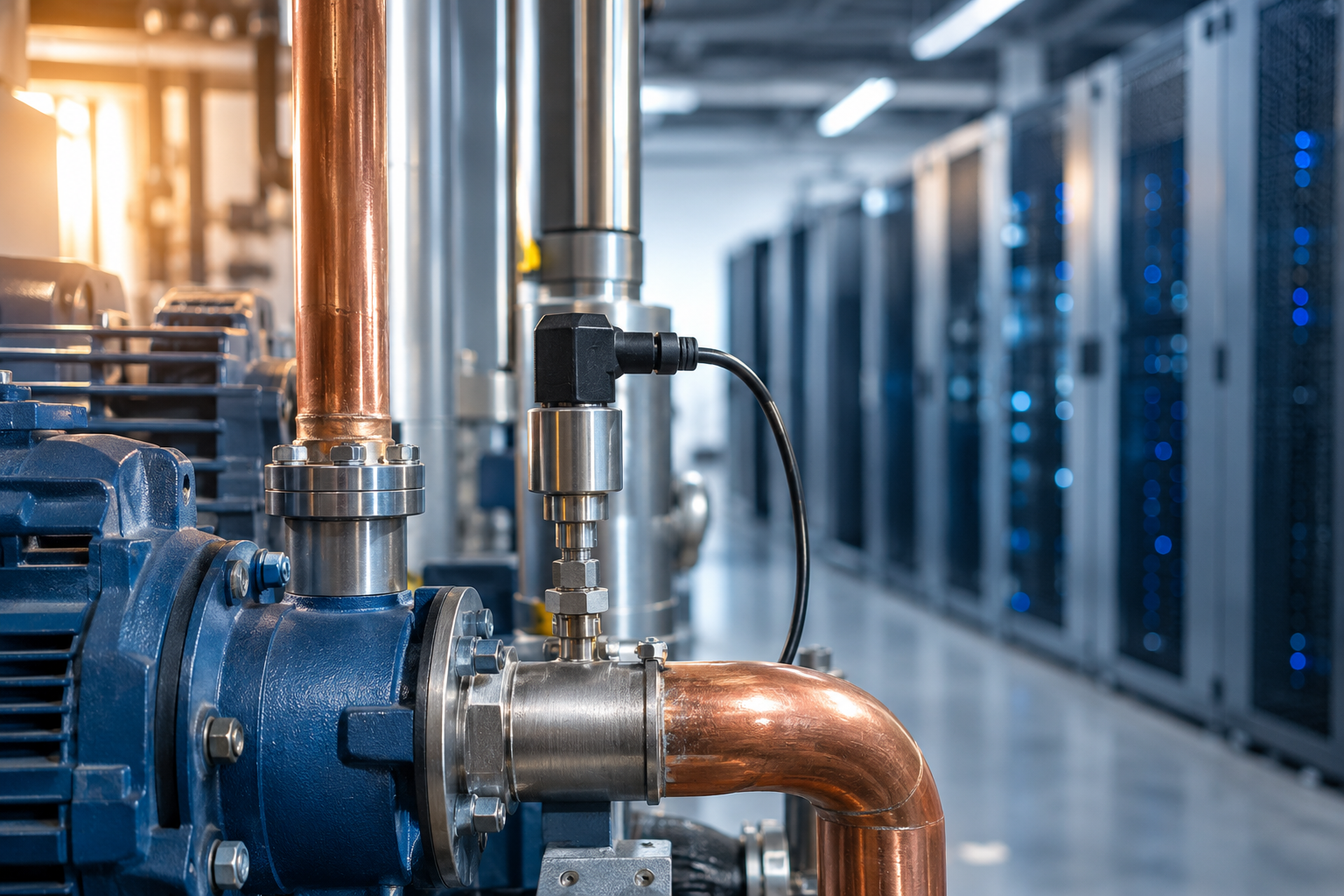


In 2025, German data centres had 2,980 megawatts of IT capacity. By 2030 the figure is set to exceed 5,000 megawatts, according to Bitkom, the German digital industry association. For mechanical engineering, meanwhile, the German machinery association VDMA expects 2026 to bring the fourth drop in production in a row. At first glance, the two numbers have nothing to do with each other.
In short: For many machinery and plant manufacturers, the data centre build-out is one of the few areas still growing, above all in cooling, power distribution, heat recovery and sensor technology. Winning orders there takes executives who can bring mechanics, electrical engineering and project business together. That profile is rare, and the job cuts across the industry do not automatically put it on the market.
Where does the data centre boom meet mechanical engineering?
From the outside, a data centre is a building full of servers. For mechanical engineering, the interesting part is everything else. According to Bitkom's market study from November 2025, around €12 billion went into IT hardware in 2025 and €3.5 billion into buildings and technical building services. Roughly €2.5 billion of that was spent on climate control, power and other building technology, more than ever before. This second figure is the market that matters to machinery manufacturers.
The driver is artificial intelligence. Bitkom expects AI capacity in German data centres to quadruple by 2030, from 530 to around 2,020 megawatts. Its share of total capacity would rise from about 15 to 40 per cent.
McKinsey partner Johan Rauer listed the areas that stand to benefit in an interview with the German trade magazine Produktion:
- Cooling, including liquid cooling, pumps, valves and heat exchangers
- Power supply with modular power units, switchgear and power distribution
- Energy efficiency through heat recovery, variable-speed pumps and frequency converters
- Automation, sensor technology and building automation, all the way to fire protection and predictive maintenance
What stands out about this list is how little of it is classic steel fabrication. Anyone supplying a pump to a data centre today is selling a controlled system with sensors, a link to the building management system and proof of efficiency. The housing is the smallest part of the offer. The value lies in the controls, the electronics and the software.
Why does the Energy Efficiency Act turn engineering know-how into a selling point?
Germany sets its own efficiency requirements for data centres through the Energy Efficiency Act (Energieeffizienzgesetz, EnEfG). The most important metric is Power Usage Effectiveness, or PUE. It puts a data centre's total energy consumption in relation to the consumption of its IT. A PUE of 1.2 means that for every kilowatt hour used by the servers, no more than 0.2 kilowatt hours may be added for cooling, power distribution and everything else.
Here it pays to separate the law as it stands from the planned amendment:
- Under the current EnEfG, data centres that start operating on or after 1 July 2026 must achieve a PUE of 1.2. Less stringent values apply to existing facilities.
- For new data centres, the act sets minimum shares of reused waste heat: 10 per cent for those starting operation from 1 July 2026, 15 per cent from 1 July 2027 and 20 per cent from 1 July 2028.
- On 24 June 2026 the federal government adopted an amendment. Under it, the PUE of 1.2 remains for new builds, but they get four years instead of two to reach it as an annual average. Existing facilities would have to meet a PUE of 1.6 from July 2027 and 1.4 from July 2030. The requirement for 100 per cent green electricity would move from 2027 to 2030, and in many cases waste heat would only have to be used if a heating network is within reach.
- This amendment is not yet in force. The Bundestag debated it at first reading on 24 September 2026, and the Committee on Economic Affairs held a public hearing on 5 October. It can still change before it is passed.
Even in the relaxed version, the 1.2 target stays in place for new facilities. No operator reaches that value with off-the-shelf technology. It takes efficient cooling, well-controlled pumps and waste heat recovery that pays for itself. For your sales team, this means the strongest argument is not the price per pump but the verifiable kilowatt hour a customer saves with it.
Which executives do machinery manufacturers need for the data centre business?
In our view, four positions decide whether a mid-sized machinery manufacturer gains a foothold in the data centre market:
- Head of Sales or Key Account Manager Data Centres: knows operators, general contractors and building services engineering consultancies, and sells projects rather than catalogue products.
- Technical Director or Head of R&D with genuine overlap between thermodynamics, electrical engineering and control engineering.
- Head of Project Management and Commissioning, who works on site alongside electrical, construction and IT trades against fixed deadlines.
- Head of Service, who turns maintenance contracts, remote monitoring and condition data from the sensors into a business of its own.
What all four roles have in common is that an understanding of electrical systems and software counts for more than in classic series machine building. The profile is shifting from “can weld and design” to “understands how mechanics, measurement technology and controls work together”.
These are exactly the people you are competing for with an industry that is currently doing better. In its economic survey for the third quarter of 2026, the VDMA notes that the electrical and electronics industry is benefiting from the heavy investment in artificial intelligence. An electrical engineer with leadership experience gets good offers there at the moment. You need to be able to explain why they should move to a pump or plant manufacturer instead.
Are the job cuts in mechanical engineering enough to fill these positions?
The figures from the same VDMA survey suggest a relaxed candidate market at first. More than 30 per cent of the companies surveyed say they have to cut jobs, while only 18 per cent plan to hire. According to VDMA chief economist Johannes Gernandt, around 100,000 jobs have disappeared from German machinery and plant engineering since 2019.
In our experience, this does little for the four roles above. Someone who has spent years in series machine building for the car industry brings a great deal of manufacturing knowledge. Project business with data centre operators, building services planning and the mix of control and electrical engineering are less often part of the package. A larger pool of candidates therefore does not mean the right profiles are in it. We have described the same pattern for executives in the construction industry: high unemployment across the board and a bottleneck at the top can exist side by side.
An example from our consulting practice, anonymised for illustration: An industrial pump manufacturer with around 250 employees wanted to enter the data centre business. The first idea was to move an experienced sales director from within the company into the role. He had known the buyers in the chemical industry for twenty years, but nobody at colocation providers or at the engineering consultancies that put cooling concepts out to tender. The position was eventually filled by an executive from refrigeration and air conditioning who had previously been responsible for projects for data centre operators. She had got to grips with her new employer's products within a few months. Going the other way, building that network would have taken years.
Moves across industry lines like this carry more risk than hiring someone from your own segment. That is why it is worth assessing career changers systematically, for example with structured management diagnostics, instead of relying on the CV alone.
What does the build-out mean for companies in Bavaria, North Rhine-Westphalia and Baden-Württemberg?
The market is heavily concentrated by region. According to Bitkom, Hesse, and the Frankfurt area in particular, accounts for more than a third of installed capacity at just over 1,100 megawatts. Bavaria has 420 megawatts, North Rhine-Westphalia 378 and Baden-Württemberg 233. Planned projects include more than 1,800 megawatts in Frankfurt, 888 megawatts in Brandenburg and 480 megawatts in Nierstein in Rhineland-Palatinate.
For suppliers from Munich, the Rhineland or the Ulm area, this means the customers are often not on the doorstep. Project managers and sales staff have to be prepared to travel regularly to Frankfurt or Brandenburg, and that belongs in the requirements profile from the start of the search. If you are a mid-sized company recruiting in the Ulm and Neu-Ulm region, we know the local market through our HR consultancy in Ulm.
What should you check now?
Before you advertise a position for the data centre business, five questions help:
- Which of your products fit specifically into cooling, power distribution, waste heat recovery or monitoring?
- Does anyone in your sales team already have access to operators, general contractors and building services planners?
- Can your R&D team supply efficiency figures that an operator can use to make its case under the EnEfG?
- Who in your company leads projects on other people's construction sites with fixed commissioning dates?
- For which role would you be better off searching outside your own segment, for instance in refrigeration, air conditioning or electrical engineering?
If the honest answer to several of these is “nobody”, that is no reason to drop the subject. It tells you which position to fill first. How a search like this runs discreetly, without competitors or your own workforce finding out, is described in our article Headhunter for mechanical engineering: fill roles discreetly.
Frequently asked questions about data centres and mechanical engineering
Which areas of mechanical engineering benefit from new data centres?
Mainly cooling with pumps, valves and heat exchangers, power distribution with switchgear, heat recovery solutions, and sensor and building automation technology. According to Bitkom, around €2.5 billion went into climate control, power and other building technology for data centres in 2025.
What does a PUE of 1.2 mean?
Power Usage Effectiveness puts a data centre's total energy consumption in relation to its IT consumption. At 1.2, every kilowatt hour for the servers may be accompanied by no more than 0.2 kilowatt hours for cooling, power distribution and other technology. Under the Energy Efficiency Act, this value applies to data centres that start operating on or after 1 July 2026.
Is the waste heat obligation for data centres already in effect?
Yes. Under current law, new data centres starting operation on or after 1 July 2026 must reuse at least 10 per cent of their waste heat, rising later to 15 and then 20 per cent. An amendment to the Energy Efficiency Act that would tie this obligation to an accessible heating network is going through parliament but has not yet been passed.
Why do machinery manufacturers struggle to find suitable executives for this business despite job cuts?
Because the profile they need sits at an interface: mechanics, electrical and control engineering, plus experience in project business with data centre operators. People let go from series machine building rarely bring that combination. Targeted direct approach in neighbouring industries such as refrigeration and air conditioning usually has better prospects.
Talk to us about your next key position
Schlagheck + Radtke fills specialist and leadership positions in machinery and plant engineering, such as technical directors, heads of sales and project managers, from our offices in Düsseldorf, Munich and Ulm. If you are building up a data centre business and need the right executive to lead it, get in touch. A first conversation comes with no obligation.